"How much does a corporate event cost?" is one of the hardest questions to answer honestly, because the same sentence can describe a 40-person executive dinner and a 1,200-person product launch. What you are really asking is: what does it cost to produce the experience I have in mind, done well, with nothing falling through the cracks? This guide breaks the number down the way a planner actually builds it.
What "full-service" corporate event planning includes
Corporate event pricing varies so widely because "event planning" can mean very different things. Full-service production — the kind that lets your team show up and simply host — typically covers:
- Concept, design, and floor plan — the creative direction and spatial layout that make a room feel like your brand, not the venue's.
- Planning, timelines, and run-of-show — the schedule that keeps a multi-part program on cue.
- Florals, decor, and draping — including the large-scale floral and environmental installations that define a space.
- Lighting, sound, and AV — the production layer that carries a keynote or a reveal.
- Vendor sourcing and coordination — one point of contact managing every moving part.
- On-site management the day of — so the people who planned it can finally enjoy it.
When a quote looks dramatically cheaper than another, it is almost always because it covers a narrower slice of that list. The single most useful question to ask any planner is simple: what is included, and what is not? A $12,000 proposal and a $45,000 proposal can both be honest — they are just describing different amounts of work.
What corporate events cost by type
Budget tracks the ambition and the audience more than anything else. Here is how the most common corporate formats tend to scale, and why.
Executive dinners and client receptions
Intimate, high-touch, and design-forward. The guest count is low, but the standard is high — bespoke tablescapes, considered florals, and flawless service. These are often the most efficient way to spend a corporate hospitality budget.
Brand activations and experiential events
A brand activation is priced around its build: the more immersive and custom the environment, the more fabrication and installation it requires. The visual ambition is the budget here, because the experience is the deliverable.
Conferences and summits
Multi-day conferences and summits carry the most moving parts — general-session staging, branded environments, breakout spaces, and a run-of-show that spans days. More days and more sessions mean more production, which is why summits sit at the higher end.
Galas and fundraisers
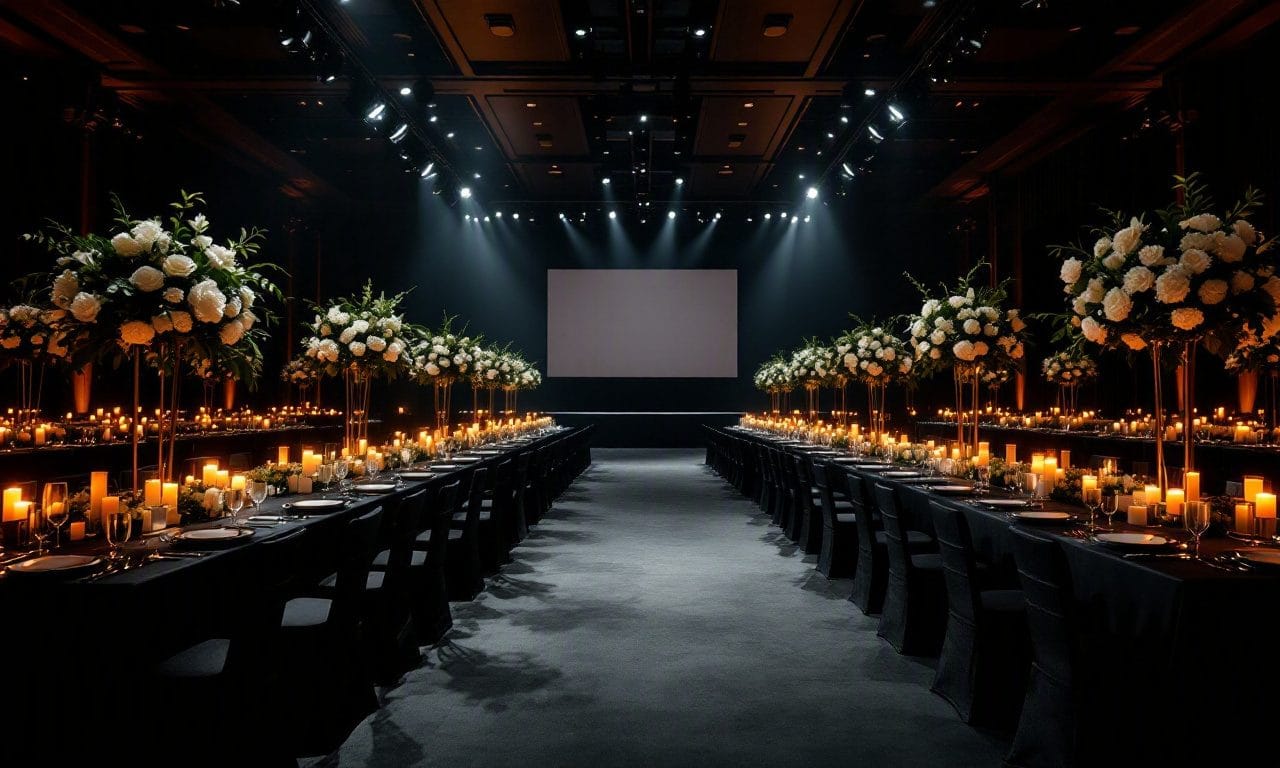
A gala is judged on how the room feels the moment guests walk in. Scale of florals, stage design, and guest count are the main levers — and for nonprofits, that investment is what sets the emotional tone before the ask.
Product launches
A product launch concentrates the budget on one moment: the reveal, and the photograph that travels afterward. Spend follows the set, the lighting, and the press experience.
Planning a corporate event in Atlanta?
Tell us your date, guest count, and vision — we'll send a tailored proposal so you know exactly what your event will cost.
Start Your InquiryWhat drives the cost up or down
Guest count and venue
More guests means more seating, florals, catering coordination, and staff. The venue matters just as much: a raw, blank space that needs full buildout costs more to transform than one that is already event-ready. A beautiful venue can lower your design spend; a warehouse can raise it — but it can also become something unforgettable.
Design ambition
Lush floral installations, custom structures, and dramatic lighting are where a room goes from "nice" to unforgettable — and they are the single biggest lever on budget. This is also where the return lives: the design is what guests photograph, remember, and associate with your brand.
Production and staffing
Stage, audio, video, rigging, and white-glove service all add up, especially for galas, conferences, and brand activations where the experience is the point. Skilled labor for load-in and strike is a real, and often underestimated, line item.
Date, season, and timeline
Peak dates (late spring, December) and short timelines both push costs up, because they compress sourcing and squeeze vendor availability. The earlier you start, the more your budget buys.
How to budget for a corporate event
You do not need a final number to start a productive conversation — you need a few anchors:
- Lead with the objective. A recruiting event, a donor gala, and a product launch deserve different investments. Decide what the event must achieve first.
- Set a range, not a single figure. A floor and a ceiling let a planner design to your reality instead of guessing.
- Decide your non-negotiables. Naming the two or three things that matter most lets the budget flex everywhere else.
- Build in contingency. Roughly 10–15% held back covers the inevitable "can we also…" moments without derailing the plan.
Where the budget tends to go
Every event is different, but a full-service production budget often breaks down along these lines, which is useful for sanity-checking any proposal:
- Design, florals, and decor — frequently the largest share, because it is what guests see, feel, and remember.
- Venue, catering, and beverage — driven by guest count and the standard of hospitality you want to set.
- Production — staging, lighting, sound, and video, scaled to the format and the room.
- Planning, coordination, and on-site management — the expertise that keeps everything on time and on brand.
- Rentals and logistics — furniture, linens, delivery, and the unglamorous pieces that make the rest possible.
If a quote concentrates almost everything in one category and barely mentions the others, that is your cue to ask what is missing.
Full-service vs. piecing it together
It is always possible to book a florist, an AV company, a rental house, and a venue separately. Sometimes that is the right call. But for events where the experience matters — where the room is the message — a single studio owning design and production end to end is what makes scale feel effortless. One team holds the creative vision and the load-in schedule, so the florals, lighting, and staging arrive as one coherent experience instead of four separate invoices that never quite met.
What's often left out of a quote
Two proposals are only comparable once you know what each leaves out. The line items most often missing — or buried — are the ones worth asking about directly:
- Labor for load-in and strike. Setting up and tearing down a large installation is skilled, time-bound work, and tight venue windows can mean overtime.
- Power, rigging, and structural needs. Suspended florals, heavy staging, and large lighting packages sometimes require rigging, generators, or venue-imposed fees.
- Delivery, travel, and storage. Especially for events outside the city, logistics are a real cost, not a rounding error.
- Service charges, gratuity, and tax. A venue or caterer's 22–26% service charge plus tax can move a total meaningfully — always read the bottom of the estimate.
- Permits and insurance. Some venues and municipalities require certificates of insurance or permits for builds, open flame, or street access.
None of these are red flags — they are simply part of producing at scale. A good planner names them up front rather than letting them surface as surprises later.
A note on Atlanta venues
Atlanta's range of venues is part of what makes budgeting here so variable. A polished hotel ballroom in Buckhead arrives largely event-ready, so more of the budget can go to design. A raw industrial space on the Westside or a historic property may cost less to book but more to transform — power, climate, and buildout become design opportunities and line items at once. Outdoor and estate settings add weather contingencies, such as tenting, lighting, and climate control, that are worth planning from day one. The right venue for your budget is the one whose strengths match your priorities — which is a conversation worth having before you sign a venue contract, not after. If you want a head start, our Atlanta corporate event planning page covers the local landscape in more depth.
Questions to ask before you book a planner
The right questions reveal more than any price sheet. Before you sign, ask:
- What exactly is included — and what would be billed separately?
- Who is on site the day of, and who is my single point of contact?
- Do you design and produce in-house, or subcontract the creative?
- How do you handle changes after we approve the proposal?
- Can you show work at a scale and style similar to what we're imagining?
The answers tell you whether you are hiring a coordinator, a designer, or a full production studio — and which of those your event actually needs.
Is the investment worth it?
For a corporate audience, an event is a marketing and relationship channel, not just a line item. A well-produced launch earns press and content that outlive the night; a gala deepens donor and client relationships in a way no email can; a conference shapes how a company is perceived by the people who matter most to it. The real question is rarely "can we spend less?" — it is "what does it cost us if this event is forgettable?" Thoughtful design is what protects the investment, turning a budget into an experience people actually remember.
How Greystone prices corporate events
Our corporate events begin at $40,000, and floral experiences from $15,000, because we work full-service — design through flawless on-site execution, with florals, decor, lighting, sound, and video coordinated through a trusted vendor network. Rather than a fixed menu, we build a custom proposal after an initial consultation, so the investment matches the event you actually want. That approach suits the clients we serve best: companies, nonprofits planning annual galas, and hosts who care that every detail is intentional. You can see the full scope on our corporate event production page, or tell us about your event directly through the inquiry form.
Common questions
- Why do corporate events start at $40,000?
- That reflects full-service design and production — not a single service like florals alone. It is the point where we can deliver the complete, on-brand experience our clients expect, with the design and the logistics owned by one studio.
- How much does corporate event planning cost in Atlanta on average?
- It depends entirely on scope. Full-service production generally begins around $40,000, with intimate executive events near that figure and large galas, conferences, and activations climbing well beyond it based on guest count, venue, and design ambition.
- What's the difference between an event planner and an event designer?
- A planner manages logistics and timelines; a designer creates the look, atmosphere, and emotional experience. Greystone does both, plus full production — so one team owns how the event runs and how it feels.
- How far in advance should we book?
- As early as possible for the most in-demand dates. The earlier you start, the more sourcing leverage your budget has — and the more ambitious the design can be.
- Can you work within a set budget?
- Yes. If you share a realistic range and your top priorities, we design to that reality — concentrating the investment where it has the most impact and being honest about what is and isn't possible.
- Do you produce events outside Atlanta?
- Yes. Greystone is based in Atlanta and produces nationally, with travel and production logistics planned into every engagement.
Let's design something unforgettable.
Share your event details and we'll start the conversation.
Start Your Inquiry