GLP-1 satiety science & the mental chatter about food

Food Noise:
What It Is & How to
Quiet It Naturally

The constant pull toward food — the mental replays, the cravings between meals, the voice that narrates every snack in the break room — has a name. Understanding the biology behind food noise is the first step toward quieting it for good.

What is food noise? Food noise is the persistent, intrusive mental chatter about food — the constant thinking, craving, and preoccupation with eating that goes beyond physical hunger. It is a recognized pattern linked to disrupted satiety hormone signaling, particularly the GLP-1 pathway, that makes portion control feel like a daily battle of willpower rather than a natural state.

Section 1 of 6 — Definition

What is food noise, exactly?

Most people assume that wanting to eat all the time is a character flaw — a lack of willpower or discipline. The research tells a different story. Food noise is a real, biological phenomenon that researchers and clinicians increasingly use to describe the near-constant mental preoccupation with food that many people experience throughout the day.

It shows up in recognizable patterns: thinking about your next meal before you have finished the current one, replaying food choices in your head, feeling mentally "pulled" toward the kitchen even when you ate an hour ago, or finding it difficult to focus on anything else when food is nearby. It is not boredom eating, and it is not emotional eating — though it can overlap with both. Food noise is the background hum of appetite signals that refuses to quiet down between meals.

The term gained wider cultural visibility when patients using prescription GLP-1 medications began reporting, sometimes with surprise, that the "voice" about food had simply gone quiet. That observation pointed researchers toward something important: the mental experience of constant food craving is closely tied to the body's own satiety-signaling biology, especially the GLP-1 hormone pathway.

How food noise feels day to day

People who experience significant food noise often describe it as:

  • Thinking about food even shortly after a full meal
  • Difficulty concentrating at work when food is in the vicinity
  • Mentally "negotiating" with themselves about eating throughout the day
  • A low-grade sense of food urgency that only briefly resolves after eating
  • Finding that restriction amplifies the mental chatter rather than quieting it

Understanding that food noise has a biological root — not just a psychological one — reframes the problem. The goal is not to muster more willpower. The goal is to support the systems in your body that are supposed to be doing the work of feeling satisfied.

Section 2 of 6 — The Biology

The GLP-1 biology behind food noise

Your body has a built-in system for signaling satiety. Food noise is what happens when that system under-delivers.

GLP-1 — glucagon-like peptide-1 — is a hormone your gut releases in response to food. Its job is to signal fullness to your brain, slow the rate at which your stomach empties, and support stable blood sugar levels after a meal. When GLP-1 signaling is robust and well-calibrated, meals feel satisfying, cravings stay manageable between meals, and the mental background chatter about food remains relatively quiet.

When GLP-1 signaling is insufficient — whether from genetics, dietary patterns, chronic stress, or other factors — the satiety signal your brain is waiting for arrives late, weakly, or not at all. The brain interprets this as "still hungry," even when your stomach is physically full. The result is the persistent, nagging pull toward food that defines the food noise experience.

Two companion hormones work alongside GLP-1 in this system. GLP-2 (glucagon-like peptide-2) supports the health of the gut lining, helping your digestive system absorb nutrients effectively — poor gut health can undermine how well satiety signals are generated after eating. GIP (glucose-dependent insulinotropic polypeptide) helps regulate the insulin response and how efficiently your body uses food energy, influencing the reward signals that drive appetite between meals.

All three of these pathways — GLP-1, GLP-2, and GIP — are the focus of the science behind natural GLP-1 support approaches and the reason that supporting your body's own signaling biology, rather than fighting food noise with willpower alone, is the more logical long-term strategy.

GLP-1Signals fullness to the brain, slows stomach emptying, and helps calibrate blood sugar after meals — the primary satiety hormone
GLP-2Supports gut-lining health and nutrient absorption — the foundation that allows satiety signals to form correctly
GIPHelps regulate the insulin response and how your body converts food energy, influencing the reward signals that drive appetite
Section 3 of 6 — Why diets backfire

Why calorie restriction makes food noise louder

There is a cruel irony at the center of most conventional diets: the harder you restrict, the louder food noise tends to become. This is not imagination — it is biology, and it helps explain why willpower-based approaches to eating less so often fail long-term.

The restriction feedback loop

When calorie intake drops significantly, the body reads the reduction as a signal of scarcity. In response, it turns up appetite hormones — particularly ghrelin, the "hunger hormone" — and simultaneously reduces or delays GLP-1 satiety signals. The effect is a biological one-two punch: you feel hungrier than you did before you started dieting, and your body's ability to generate a satisfying "done eating" signal is weakened.

This is not a flaw in your character. It is an adaptive response your body developed over hundreds of thousands of years to protect against starvation. The problem is that in a modern environment with abundant, hyper-palatable food, those same protective mechanisms become a source of persistent food noise rather than a survival advantage.

The ultra-processed food amplifier

Modern food environments compound the problem. Highly processed foods are engineered to delay satiety signaling while maximizing the brain's dopamine reward response to eating. The combination — a weakened GLP-1 satiety signal and a heightened dopamine reward from the food itself — creates ideal conditions for intense, persistent food noise. You finish a bag of chips and feel immediately ready to eat more, while a similar calorie count in whole foods would leave you satisfied for hours.

Understanding this cycle is important because it clarifies the target: the goal of natural appetite support is not to suppress hunger through deprivation but to help restore the body's own satiety signaling so that appropriate portions feel genuinely satisfying rather than painfully inadequate.

Restriction

Hunger hormones rise

Calorie cutting triggers ghrelin increases and suppresses GLP-1 output — the body fights back against restriction biologically.

Processed food

Satiety signals delayed

Ultra-processed foods maximize dopamine reward while blunting the gut's ability to generate timely GLP-1 satiety responses.

The loop

Willpower depletes

Louder food noise exhausts your capacity for self-regulation — making the next bout of overeating more likely, not less.

Tired of the mental chatter? triGLP supports your body's own GLP-1, GLP-2, and GIP satiety signaling — helping your appetite system do the work so you don't have to fight it all day. Individual results vary.

Shop triGLP →
Section 4 of 6 — Natural strategies

Natural ways to quiet food noise

Supporting your satiety biology works from multiple angles. These approaches reinforce one another rather than standing alone.

1. Prioritize protein at every meal

Protein is the most potent dietary trigger for GLP-1 secretion. Higher-protein meals stimulate more robust satiety signaling, helping the "I'm full" message arrive at your brain faster and last longer. Centering each meal around a quality protein source — eggs, fish, poultry, legumes — is one of the most consistently supported natural appetite-support strategies in the nutrition literature.

2. Eat foods that slow digestion

Fiber-rich vegetables, legumes, and intact whole grains slow the rate at which your stomach empties, prolonging the window in which GLP-1 is actively being secreted. This extended satiety window is a key reason that whole-food diets tend to quiet food noise more effectively than ultra-processed alternatives with similar calorie counts.

3. Stabilize blood sugar with meal timing

Sharp blood sugar rises followed by rapid drops are a consistent trigger for intense food noise — particularly the urgent, grab-something-now craving that often hits in the mid-afternoon. Spacing meals to avoid extended fasts while avoiding large simple-carbohydrate boluses helps keep blood sugar — and food noise — on a more even keel.

4. Prioritize sleep quality

Even a single night of poor sleep measurably reduces GLP-1 output and elevates ghrelin. Chronic sleep disruption essentially reprograms your appetite biology toward higher baseline hunger and more persistent food noise. Seven to nine hours of quality sleep is not optional for appetite regulation — it is the foundation.

5. Reduce chronic stress

Elevated cortisol from ongoing stress both stimulates appetite directly and suppresses the sensitivity of satiety receptors. Stress-management practices — whether structured mindfulness, regular physical movement, or simply protecting recovery time — have a meaningful downstream effect on how loud food noise gets during stressful periods.

6. Support your body's GLP-1 signaling with targeted nutrition

Beyond lifestyle factors, some people benefit from nutritional support designed specifically to reinforce the body's own GLP-1 satiety pathway. This is the rationale behind natural GLP-1 support supplements like triGLP — not replacing the body's own signaling, but giving it the building blocks it needs to work more effectively. We cover this approach in detail in the next section.
Section 5 of 6 — triGLP & food noise

How triGLP supports the body's own satiety signaling

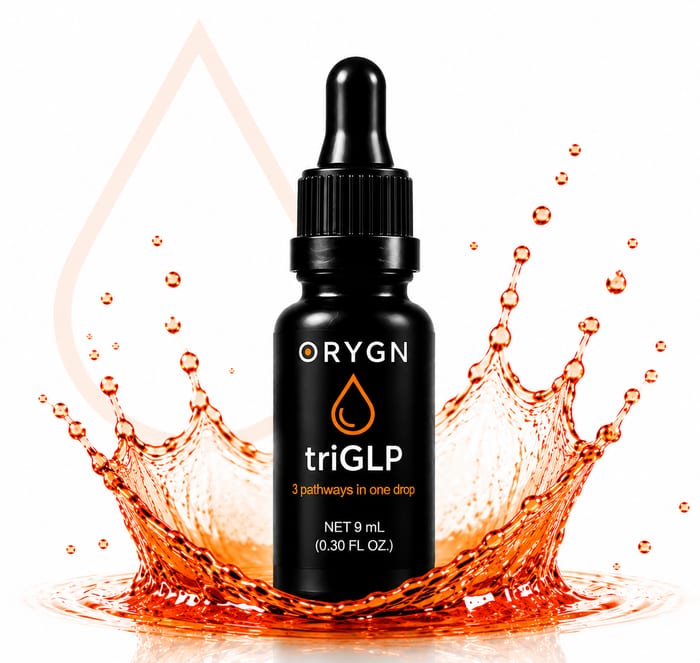
triGLP is built on the same GLP-1 biology that makes food noise quiet down — delivered naturally, as drops.

NDI StatusProGo® holds FDA New Dietary Ingredient designation — the regulatory foundation for novel supplement ingredients
13 ClaimsFDA-recognized structure/function claims the agency has not objected to, covering metabolic and satiety support
In-VitroProGo® peptides activated GLP-1 and GIP receptors in cell-based laboratory studies — the same receptors behind today's metabolic science
3 PathwaysGLP-1 satiety signaling, GLP-2 gut support, and GIP metabolic regulation — all supported by one natural drop formula

triGLP is a natural metabolic-support supplement made with ProGo® — a patented bioactive peptide derived from sustainably sourced Norwegian Atlantic salmon. In laboratory (in-vitro, cell-based) studies, the smallest of these peptides activated GLP-1 and GIP receptors — the same receptor pathways at the center of today's metabolic science.

The connection to food noise is direct: when GLP-1 receptor signaling is supported, the brain receives clearer and more timely satiety cues after eating. Smaller portions feel genuinely satisfying. The mental negotiation that characterizes food noise — the constant checking in with your appetite, the urge to eat again 45 minutes after a meal — becomes quieter as the body's own signaling takes over.

triGLP is not a prescription GLP-1 medication, and it does not introduce a synthetic drug into your system. It works by supporting the biological pathways your body already uses, through a food-grade, naturally derived ingredient. This is a meaningful distinction: supporting your own satiety biology versus overriding it pharmacologically are different approaches with different risk profiles, regulatory statuses, and appropriate use cases.

ProGo® is taken as drops under the tongue — not an injection. It holds NDI status with 13 structure/function claims the FDA has not objected to, and the ingredient has been the subject of peer-reviewed pre-clinical and clinical research over more than a decade.

For people experiencing food noise who want to support their body's natural satiety system rather than fight it through restriction alone, triGLP represents a targeted, biology-first approach to quieting the chatter. Individual results vary.

Section 6 of 6 — Telling them apart

Food noise vs. real hunger: how to tell the difference

Not every urge to eat is food noise. Learning to distinguish them is a practical skill that supports better eating decisions.

One of the most practically useful things you can do to manage food noise is learn to distinguish it from genuine physical hunger. They can feel similar — especially when food noise is loud — but they have meaningfully different characteristics.

Signal Real Hunger Food Noise
Onset Builds gradually, 3–5 hours after a meal Appears suddenly, often shortly after eating
Physical signals Stomach growling, low energy, mild light-headedness Mental craving, no physical stomach emptiness
Food specificity Open to most foods — an apple would be welcome Fixated on specific, often hyper-palatable foods
Urgency quality Can be delayed comfortably for 30–60 minutes Feels urgent even when you know you are not hungry
After eating Resolves fully; satisfied feeling lasts hours Briefly quiets, then often returns quickly
Emotional quality Relatively neutral; a practical need May feel compulsive, guilty, or hard to dismiss

A practical pause test

When you notice an urge to eat, pause for two minutes and ask three questions: When did I last eat? Is my stomach physically empty? Would I be satisfied eating a simple, whole food right now — or am I fixated on something specific?

If the answers point toward "not long ago," "not physically empty," and "craving something specific," what you are experiencing is likely food noise rather than physical hunger. That recognition itself — naming the experience — is the first step toward responding to it differently.

Combining that mindfulness practice with active support for your GLP-1 satiety biology — through diet, sleep, stress management, and targeted nutritional support — gives you both a psychological and a physiological tool for quieting food noise over time.

Frequently asked questions

Food noise — your questions answered.

What is food noise?

Food noise is the persistent, intrusive mental chatter about food — constant thoughts, cravings, and preoccupation with eating that goes well beyond physical hunger. Researchers and clinicians increasingly link it to disrupted satiety hormone signaling, particularly in the GLP-1 pathway, which is responsible for sending "I'm full" signals from your gut to your brain.

What causes food noise?

The main driver of food noise is insufficient or delayed satiety signaling — particularly GLP-1, the gut hormone that tells your brain you have eaten enough. Contributing factors include genetics, ultra-processed food consumption (which blunts GLP-1 output), chronic calorie restriction, sleep deprivation (which measurably reduces GLP-1 and raises hunger hormones), and ongoing stress (which elevates cortisol and suppresses satiety receptor sensitivity).

How do you stop food noise naturally?

Natural strategies for quieting food noise focus on supporting the body's own satiety biology: prioritizing protein at every meal (the strongest dietary trigger for GLP-1 secretion), eating fiber-rich whole foods that slow stomach emptying, stabilizing blood sugar with consistent meal timing, protecting sleep quality, managing chronic stress, and — for targeted support — considering natural GLP-1 support supplements like triGLP that are designed to reinforce the GLP-1 satiety pathway.

Is food noise the same as being hungry?

No. Real hunger builds gradually, is accompanied by physical signals (stomach growling, low energy), and resolves fully after eating any satisfying food. Food noise tends to appear suddenly, often shortly after a meal, is mentally fixated on specific hyper-palatable foods rather than any food, and only briefly quiets before returning. The key distinction: real hunger is a physical signal; food noise is a mental one tied to disrupted satiety signaling.

What is a food noise supplement?

A food noise supplement is a natural dietary supplement designed to support the body's satiety signaling pathways — particularly GLP-1 — to help reduce the frequency and intensity of food cravings between meals. triGLP is one such supplement, made with ProGo® salmon-derived bioactive peptides that were shown in cell-based laboratory studies to activate GLP-1 and GIP receptors. It is not a prescription medication and should not be compared to prescription GLP-1 medications.

Does GLP-1 support help quiet food noise?

Patients using prescription GLP-1 medications were among the first to widely report that their food noise had gone quiet — an observation that highlighted how central GLP-1 satiety signaling is to the experience of constant food craving. Supporting your body's natural GLP-1 output through diet and targeted nutritional support works by the same underlying logic: when satiety signals are clearer and more timely, the mental chatter about food tends to become less loud. Individual results vary.

How is triGLP different from prescription GLP-1 medications?

triGLP is a natural dietary supplement — not a prescription medication. Prescription GLP-1 medications are synthetic pharmaceutical drugs that require a doctor's prescription and work by introducing a drug compound into your system at pharmacological doses. triGLP works by supporting the GLP-1, GLP-2, and GIP receptor pathways your body already uses, through a food-grade, naturally derived salmon peptide ingredient (ProGo®) with FDA New Dietary Ingredient status. These are fundamentally different approaches with different regulatory classifications, risk profiles, and appropriate use cases.

Where can I buy triGLP?

triGLP is available exclusively through the official ORYGN store. You can shop securely from any "Shop triGLP" button on this page — all of which link to the official replicated store. This is an independent Shopping Different affiliate page; all purchases are fulfilled by ORYGN directly.

Ready to quiet the food noise?

Support your body's own GLP-1 satiety signaling — the biology behind feeling genuinely satisfied with less, naturally. Individual results vary.

Shop triGLP →