The two incretins beyond GLP-1

GLP-2 & GIP, Explained
The Two Incretins Beyond GLP-1

Nearly every conversation about metabolic support starts and stops with GLP-1. But your gut runs on a trio of incretin signals, and the other two — GLP-2 and GIP — do work GLP-1 never touches. Here's what each one does, how they differ, and why Ignyt Powder is built around all three instead of one.

What are GLP-2 and GIP? GLP-2 and GIP are two of the gut's incretin hormones — the same family as the better-known GLP-1. GLP-2 supports the intestinal lining and how efficiently nutrients are absorbed, shaping digestive comfort. GIP helps the body handle the fuel from a meal, favoring fat as an energy source while helping preserve lean tissue. Ignyt is designed with all three in mind.

Tri-PathwayGLP-1, GLP-2 & GIP receptor support
ORYGN PURE™Controlled-extraction salmon peptide
NDI StatusProGo® FDA New Dietary Ingredient
One StickStir into 8 oz water — no measuring
Section 1 of 5 — Beyond GLP-1

Why the incretin story doesn't stop at GLP-1

GLP-1 earns the headlines because it's the appetite signal. But it shares the stage with two lesser-known incretins that quietly shape digestion and energy.

Open almost any article about metabolic support and you'll meet GLP-1 in the first sentence. It's the incretin tied to appetite and satiety — the one people mean when they talk about quieting cravings, that low background hum of wanting to eat. It earns the attention. But treating GLP-1 as the whole story is a bit like judging an orchestra by a single instrument.

Incretins are hormones your gut releases in response to food. They're the messengers connecting what you eat to how your body responds — hunger, digestion, energy. GLP-1 is only the most famous member of that group. Two others, GLP-2 and GIP, work right alongside it, and most GLP-1 talk never so much as names them.

The three signals, at a glance

  • GLP-1 — the appetite and fullness signal; the reason food noise can quiet down.
  • GLP-2 — the gut-lining and nutrient-absorption signal; the one tied to how comfortable digestion feels.
  • GIP — the fuel-handling signal; the one involved in what the body does with the energy in a meal.

Appetite, digestion and fuel use aren't three separate systems that happen to sit near each other. They're a connected loop, and the incretins are how the gut keeps them coordinated. That's the whole reason the sections below give GLP-2 and GIP as much room as GLP-1 — and why Ignyt was designed around the trio rather than a single pathway.

Section 2 of 5 — GLP-2

GLP-2: the gut-lining and absorption signal

If GLP-1 works on your appetite, GLP-2 works on the organ that's doing the digesting.

GLP-2 (glucagon-like peptide-2) is released from the same gut cells as GLP-1, but its focus points inward, at the intestine itself. Where GLP-1 talks to the brain about hunger, GLP-2 tends to the lining of the gut — the thin surface where nutrients actually cross from your meal into your body.

That surface matters more than most people realize. It decides what gets absorbed and what stays out, and when it's doing its job well, digestion simply feels easier — less of the bloating, heaviness and unpredictability people file under "a sensitive stomach." When it isn't, a lot of the signals downstream get noisier.

What GLP-2 is associated with

  • Supporting the integrity of the intestinal lining — the barrier your nutrients pass through
  • Helping the gut take up nutrients from food efficiently
  • Contributing to the kind of steady digestive comfort that's easy to take for granted until it's gone

None of this is about treating a condition — it's ordinary structure and function, the daily housekeeping a healthy gut does. But it's foundational. A comfortable, well-functioning gut is the platform the other two signals stand on, which is exactly why leaving GLP-2 out leaves the picture half-finished. For a deeper look at gut-lining support on its own, the gut health supplement guide goes further.

Section 3 of 5 — GIP

GIP: how your body handles the fuel from a meal

GIP is the incretin that gets involved after you eat — the moment the body has to decide what to do with the energy that just arrived.

GIP (glucose-dependent insulinotropic polypeptide) has the least name recognition of the three and, unfairly, the most intimidating name. Its role is easy to grasp, though, once you stop picturing metabolism as a furnace and start picturing it as a sorting system.

Every meal delivers fuel — sugars, fats, amino acids. Something has to decide where that fuel goes: put to use now, or set aside for later. GIP is part of that decision. It's the incretin most involved in fuel handling — the moment-to-moment work of partitioning what you've eaten toward energy rather than simply stockpiling it.

What GIP is associated with

  • Helping the body process the energy that arrives with a meal
  • Supporting steadier energy instead of the spike-and-crash pattern some meals produce
  • Playing a part in how the body partitions fuel — a piece of the "favor fat as fuel" idea explored just below

Notice what GIP isn't. It isn't the appetite signal, and it isn't the gut-lining signal. It works in its own lane, downstream of eating and focused on fuel. That's precisely why supporting GLP-1 alone can't stand in for it — the three signals genuinely do different jobs.

Section 4 of 5 — Together

GLP-2 and GIP together: favoring fat as fuel while protecting lean mass

Separately, each signal does one job. The interesting part is what they're associated with when both are supported at the same time.

Here's where the tri-pathway idea earns its name. GLP-2 keeps the gut absorbing and digesting comfortably; GIP helps steer the incoming fuel toward energy. Supported together, they contribute to a metabolic setting a lot of people are actually after — one where the body is nudged toward drawing on fat as a fuel source while helping hold onto lean tissue.

It's worth being precise here, because this is easy to overstate. Nobody can guarantee body composition, and this isn't a claim that a supplement rearranges your body for you. What the tri-pathway design aims at is structure-and-function support — helping the body's own signals do what they're built to do, so that when you put in the work, the underlying system is cooperating rather than working against you.

Why "burn fat, not muscle" needs softening

You'll see the shorthand "burn fat, not muscle" all over this category. It's a catchy way to describe a real preference the body can lean into — using fat stores for energy while sparing lean mass — but as a promise it goes too far. The honest version reads more like this:

  • Supporting GIP is associated with helping the body favor fat as a fuel source — not force the outcome
  • Supporting GLP-2 helps keep nutrient absorption steady, which matters when you're trying to preserve lean tissue
  • The leaner, more energetic feeling people hope for depends on diet, movement and consistency — not the supplement on its own

Framed that way, the combination is genuinely compelling without wandering into guarantees. Support is not the same thing as a result, and individual results vary.
Section 5 of 5 — Tri-Pathway Design

How Ignyt is built to touch all three at once

Understanding the three signals is the setup. Ignyt's design is the payoff — a single daily drink aimed at every one of them.

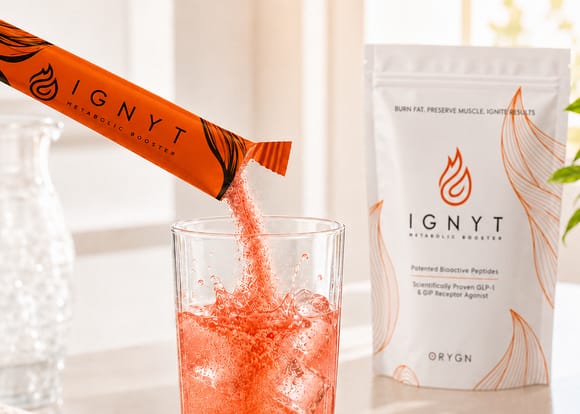
Once you can see GLP-1, GLP-2 and GIP as a connected trio, Ignyt's approach makes sense. Rather than picking one pathway and optimizing only for it, the formula is built around an ingredient studied for engaging more than one incretin receptor — so a single cran-apple drink stick can aim at appetite, gut function and fuel handling together.

The active ingredient is ProGo®, a bioactive peptide refined from salmon through a controlled extraction process and held to the ORYGN PURE™ standard. In cell-based laboratory studies, the peptide was shown to engage GLP-1 and GIP receptors — the receptor biology at the heart of the tri-pathway design. Those references describe the ProGo® ingredient itself, not what any finished product will do for a given person, and individual results vary. It's the same studied peptide behind triGLP, delivered here as a powder instead of drops.

What "tri-pathway" looks like in a single stick

  • One stick stirred into about eight ounces of water, once a day — twenty-eight sticks to a bag
  • An ingredient studied for engaging incretin receptors, rather than a single-pathway approach
  • A low-Dalton, hypoallergenic peptide described as body-friendly, made to work with the body's own signaling

If you want the step-by-step mechanism, the how Ignyt Powder works guide walks through each pathway in turn, and the Ignyt Powder overview pulls the whole tri-pathway story into one place. Ignyt is a dietary supplement, not a medication.

Frequently asked questions

GLP-2 and GIP — your questions answered.

What is GLP-2?

GLP-2 (glucagon-like peptide-2) is an incretin hormone released by the gut, closely related to GLP-1. Instead of acting on appetite, it works on the intestine — supporting the integrity of the gut lining and how efficiently nutrients are absorbed. It's the pathway most associated with steady digestive comfort.

What is GIP?

GIP (glucose-dependent insulinotropic polypeptide) is an incretin the gut releases after a meal. Its role centers on fuel handling — helping the body process the energy from food and partition it toward use rather than storage. That's a different job from GLP-1's appetite signaling.

How are GLP-2 and GIP different from GLP-1?

All three are incretins from the same family, but each has its own lane. GLP-1 governs appetite and fullness, GLP-2 tends to the gut lining and nutrient absorption, and GIP is involved in how the body handles the fuel from a meal. Supporting one doesn't substitute for the others — which is why Ignyt is designed around all three.

Can a supplement actually support GLP-2 and GIP?

A supplement can be designed to support these pathways, with the honest framing being structure-and-function support rather than a drug effect. Ignyt is built on ProGo®, a salmon peptide shown in cell-based studies to engage incretin receptors. Those studies describe the ingredient, not guaranteed outcomes, and individual results vary.

Is supporting GLP-2 and GIP the same as taking a prescription incretin drug?

No. Prescription incretin medications are synthetic pharmaceuticals that act at pharmacological doses and require a doctor. Ignyt is a dietary supplement made with a food-derived salmon peptide, designed to support the GLP-1, GLP-2 and GIP pathways the body already uses. They're different categories with different regulatory status and different uses.

Does Ignyt Powder support GLP-2 and GIP specifically?

Ignyt's tri-pathway design targets GLP-1, GLP-2 and GIP together, using the same studied ProGo® peptide found in triGLP. See how Ignyt Powder works for the mechanism, or the Ignyt Powder overview for the full picture.

Why do most GLP-1 supplements ignore GLP-2 and GIP?

Mostly because GLP-1 gets the headlines — it's the appetite pathway people have already heard of. GLP-2 and GIP are less familiar, so they tend to be left out of the conversation, even though they handle digestion and fuel. Ignyt's tri-pathway approach exists precisely to bring all three into one daily routine.

Three signals, one daily stick

GLP-1, GLP-2 and GIP each do a job the others can't — appetite, gut function and fuel handling. Ignyt Powder is built around all three, using the same studied ProGo® peptide as triGLP in a once-a-day cran-apple drink. Individual results vary.

Shop Ignyt →