Ignyt is a cran-apple drink stick, but underneath the flavor is a specific idea about how your body manages food. This page walks the whole mechanism in plain English — the incretin signals it's designed to support, the GLP-1, GLP-2 and GIP pathways one at a time, and why the same studied ProGo® peptide behind the drops is delivered here as a full-dose powder you stir into water.
How does Ignyt Powder work? Ignyt Powder works by supporting three of the body's own incretin signals at once. Each cran-apple stick dissolves the full studied dose of ProGo®, a salmon-derived peptide, into a glass of water. Once inside, that peptide is designed to engage the GLP-1, GLP-2 and GIP receptor pathways that govern appetite, gut function and how meals become fuel.
Before we get to Ignyt itself, it helps to meet the family of signals it is built to support.
Every time you eat, your digestive tract does something quietly remarkable: it sends chemical messengers into the bloodstream to announce what just arrived. These messengers are called incretins, and they are the reason a meal does far more than fill your stomach. It changes how hungry you feel, how your gut prepares to absorb what you swallowed, and how the energy in that food gets handled.
The word "incretin" simply describes a hormone released by the gut in response to food that then goes on to influence metabolism elsewhere in the body. Picture them as the gut's status report. When nutrients touch the intestinal wall, specialized cells fire off these signals, and within minutes your brain, your pancreas and your gut lining are all reading the same memo.
Appetite isn't really decided in the stomach; it is negotiated in the brain. The catch is that the brain can't see your last meal directly. It depends on chemical updates sent from below. Incretins are a large part of that conversation, one of the ways your body keeps eating, digestion and energy use roughly in step instead of leaving each system to guess on its own.
Three incretin-family signals matter most for what Ignyt is designed to support:
Ignyt leans on all three at once — the "tri-pathway" idea — because in daily life appetite, digestion and energy are not separate switches. The rest of this page takes each signal in turn, then explains why the stick delivers its peptide as a powder you drink.
Of the three signals, GLP-1 is the one most people have already heard about — even if they've never heard its name.
GLP-1, short for glucagon-like peptide-1, is the incretin most closely tied to appetite. Your gut releases it after eating, and one of its jobs is to help register the feeling of having had enough. It also slows how quickly the stomach empties, which stretches that sense of fullness out over time rather than letting it fade minutes after the last bite.
What most people are really after when they look into GLP-1 is relief from what's often called food noise — the low, persistent background hum of wanting to eat that has little to do with genuine hunger. It is the pull toward the pantry an hour after dinner, the snack you reach for from habit rather than need. When GLP-1 signaling comes through clearly, that hum tends to get easier to ignore, and reaching for the smaller portion feels less like a standoff with yourself.
Here is the distinction that matters, and it is where honest framing counts. Ignyt is not built to flood your system or to hijack the GLP-1 pathway. It is built to support the signaling your body already runs — to help your own "I've had enough" message land more clearly, rather than manufacturing an artificial one. That is a gentler, more gradual kind of support than a pharmacological dose, and it depends on being consistent. If food noise is the specific thing you are trying to quiet, our food noise guide goes deeper on why it shows up in the first place.
GLP-1 rarely gets to do its job alone, and Ignyt is designed with its two lesser-known relatives in mind.
If GLP-1 is the signal everyone talks about, GLP-2 and GIP are the pair that quietly round out the picture. They belong to the same incretin family, they are released in the same after-meal window, and together with GLP-1 they are the reason Ignyt is described as tri-pathway rather than single-pathway.
GLP-2 is GLP-1's close cousin, but its attention is on the gut itself. It is involved in maintaining the intestinal lining, the barrier that shapes how comfortably you digest and how efficiently nutrients are taken up. A gut doing its job well tends to make the whole system run more smoothly, which is why digestive comfort belongs in any honest metabolic conversation rather than sitting off to the side as an afterthought.
GIP is the incretin most involved in what happens to the energy in a meal once it has been absorbed — how the body processes that fuel and puts it to work. Supporting GIP signaling is part of the story of steadier energy from what you eat, and of helping the body favor fat as a fuel source while working to preserve lean tissue.
These two pathways are exactly the part of the story that usually goes unexplained. If you want the full walk-through of what each one does and why it matters alongside GLP-1, the GLP-2 & GIP explainer is the deep dive.
The mechanism is only half of how it works — how the peptide reaches you every single day is the other half.
A peptide can only support a pathway if it actually makes it into your routine, day after day. This is the part of "how it works" that gets skipped most often, and it is where the powder format earns its place. Ignyt takes the same studied ProGo® peptide found in triGLP drops and delivers it a different way: as a single-serve drink stick you stir into water. Same ingredient, different delivery — neither format is more effective than the other, they simply suit different people.
Each stick is pre-portioned to carry the full studied dose of ProGo®, dissolved straight into roughly eight ounces of water. There is no dropper to count, no scoop to level, and no guessing whether you took enough. You tear, stir and drink a cran-apple beverage, and the measuring has already been done for you. For a lot of people, removing that one small piece of friction is the difference between a supplement that gets used and one that ends up forgotten in a drawer.
Peptide support is cumulative, not instant, which means the most important variable isn't any single serving — it is whether you keep going. A format you genuinely enjoy is a format you repeat. The cran-apple flavor works as a daily cue, the sealed sticks travel without a bottle, and a bag holds twenty-eight of them, one for each day of a typical cycle. None of that changes the underlying biology; it changes the odds that you will still be drinking it in week eight, which is where consistency quietly does its work.
Here is the careful part — what the research demonstrates, and just as importantly, what it does not.
The peptide behind Ignyt is ProGo®, refined from salmon through a controlled extraction process and held to the ORYGN PURE™ standard. It is a small, low-Dalton peptide, described as hypoallergenic and body-friendly, and it carries FDA New Dietary Ingredient (NDI) status along with thirteen recognized structure/function claims. That is the ingredient's paperwork. Here is what the science on it looked at.
In cell-based laboratory studies, the ProGo® peptide was shown to engage GLP-1 and GIP receptors — the very receptor biology that Ignyt's tri-pathway design is built around. In plain terms, researchers placed the peptide in contact with these receptors in a controlled lab setting and observed that it interacted with them. That is meaningful early-stage evidence that the ingredient can communicate with the right biological machinery.
It is worth being precise here, because precision is what separates honest supplement copy from hype. These study references describe the ProGo® ingredient itself, observed in cell-based models — not outcomes from any finished product, and not a prediction of what will happen for you. "Shown to engage a receptor in the lab" is a very different statement from "proven to do something specific in people," and Ignyt does not blur that line.
So the accurate way to read it is this: the ingredient has laboratory evidence of interacting with two of the three pathways Ignyt is designed to support, it holds a recognized regulatory status as a dietary ingredient, and it is the same studied peptide used in the drops. What it does inside any one person's body over any given month is not something a study of the ingredient can promise. Ignyt is a dietary supplement, not a medication, and individual results vary.
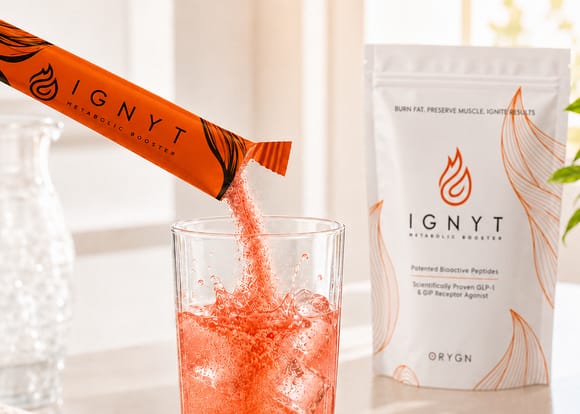
Ignyt supports three of the body's own incretin signals — GLP-1, GLP-2 and GIP — using ProGo®, a salmon-derived peptide. Each cran-apple stick carries the full studied dose, dissolved into about eight ounces of water. In cell-based laboratory studies the peptide was shown to engage GLP-1 and GIP receptors. It is a dietary supplement, not a medication, and individual results vary.
It means Ignyt is designed to support three related incretin pathways at once rather than a single one. GLP-1 is tied to appetite and food noise, GLP-2 to the gut lining and nutrient absorption, and GIP to how the body turns a meal into fuel. The GLP-2 & GIP explainer covers the two pathways most people have never had explained.
Because the format is only the delivery method — the ingredient itself is the same. Ignyt stirs the full studied dose of ProGo® into water as a cran-apple drink, while triGLP delivers that same peptide as sublingual drops. Neither is more effective; the powder simply suits people who prefer a flavored drink and a no-measuring habit. See the full Ignyt vs triGLP comparison.
Yes. Both are built on the same studied ProGo® salmon peptide, produced to the ORYGN PURE™ standard. Ignyt is the powder drink-stick format and triGLP is the drops. The mechanism they are designed to support is identical — what changes is how you take it day to day.
In cell-based laboratory studies, the ProGo® peptide was shown to engage GLP-1 and GIP receptors. ProGo® also holds FDA New Dietary Ingredient status and thirteen recognized structure/function claims. Those references describe the ingredient observed in a lab setting — not outcomes from a finished product — so they are shared for context rather than as a promise. Individual results vary.
One stick, once a day. Tear it open, stir it into about eight ounces of water, and drink — there is nothing to measure, and each stick already holds the full studied dose. A bag has twenty-eight sticks, roughly a month's worth. Consistency matters more than exact timing. As with any supplement, check with a qualified healthcare provider before starting, especially if you are pregnant, nursing or managing a health condition.
No. Ignyt is a dietary supplement made with a food-derived salmon peptide, designed to support the GLP-1, GLP-2 and GIP pathways your body already uses. Prescription GLP-1 medications are pharmaceutical drugs that work at very different doses and require a doctor. They are separate categories with different regulatory status — not the same thing and not interchangeable. Talk to your healthcare provider about what fits your situation.
Three incretin signals, one salmon peptide, one cran-apple stick you stir into water — Ignyt puts the full studied ProGo® dose into a daily habit that's easy to keep, so it can support GLP-1, GLP-2 and GIP the way your body already uses them. Individual results vary.
Shop Ignyt →