Ignyt Powder is only as good as the peptide inside it — and that peptide is ProGo®, a bioactive salmon peptide held to the ORYGN PURE™ standard. This page is about that quality story: where the peptide comes from, what a purity standard actually promises, why the peptides are small and body-friendly, and what ProGo®'s regulatory status does and doesn't mean. It's the same studied ingredient as triGLP, just examined up close.
What is the ORYGN PURE salmon peptide in Ignyt Powder? The ORYGN PURE™ salmon peptide is ProGo® — a patented bioactive peptide refined from salmon through a controlled extraction process and held to ORYGN's PURE™ purity standard. It's the small, low-Dalton, hypoallergenic peptide that powers Ignyt Powder, and the same studied ingredient found in triGLP drops. It is a dietary supplement ingredient, not a medication.
Every peptide supplement begins with a raw protein source. With ORYGN PURE™, the source is salmon — but the real story is how the peptide is separated out of it.
Salmon is a sensible place to start. It's a cold-water fish whose protein is among the most studied and best tolerated in nutrition, which is why it turns up again and again in peptide research. But a good source is only the raw material. What separates a premium peptide from a commodity fish protein is how the useful peptides are drawn out of that protein.
Crude fish-protein processing tends to break proteins down bluntly, leaving a mixed bag of large and small fragments with little consistency from one batch to the next. ProGo®, the peptide inside Ignyt, is produced through a controlled, precise extraction process instead. The aim is to isolate a specific, repeatable profile of bioactive peptides rather than whatever a rough hydrolysis happens to yield.
That precision is what makes the ingredient dependable — the reason a stick you drink today is meant to carry the same peptide profile as one you drink two months from now. A few things the controlled approach is built to protect:
In other words, the source is salmon, but the value is in the discipline of the extraction. That discipline is what the ORYGN PURE™ standard is built around — the subject of the next section.
A brand name on a peptide doesn't tell you much by itself. ORYGN PURE™ is meant to be the substance behind the name.
ORYGN PURE™ is a defined bar for what goes into every serving of Ignyt and triGLP. Rather than a vague promise of "high quality," it's meant to be a concrete set of expectations the ingredient has to meet before it earns the label.
A purity standard spells out what an ingredient must look like: the peptide profile it should carry, how small the fragments should be, and what shouldn't be present. For something you take once a day, every day, that kind of consistency matters far more than it would for a product you reach for only occasionally.
Why that matters for a daily peptide specifically:
ORYGN PURE™ is the shared standard behind both formats. That's part of why the powder and the drops can honestly be called the same studied ingredient — they're held to the same bar. The Ignyt Powder overview puts the standard in the context of the finished product.
ProGo®'s peptides are often described as small, low-Dalton, hypoallergenic and body-friendly. Those words get used loosely in supplement marketing, so here's what they actually point to.
The size of a peptide isn't a marketing flourish — it's a real property that shapes how the body deals with it. Two plain-language ideas do most of the work here: what a low-Dalton peptide is, and what "hypoallergenic" and "body-friendly" are pointing at.
A Dalton is simply a unit for measuring the weight of very small things like molecules. A "low-Dalton" peptide is a short chain of amino acids — a small fragment rather than a big, intact protein. Smaller fragments are generally easier for the body to work with, which is the everyday meaning behind the word bioavailability: how readily the body can take something up and put it to use.
Large, intact proteins are the parts of food most often tied to allergic responses. Because ProGo®'s peptides are small fragments rather than whole proteins, the ingredient is described as hypoallergenic — meaning it's formulated to be lower-risk for that kind of response, not that it's risk-free for everyone. "Body-friendly" is a related idea: a small, clean peptide the body can recognize and process without a lot of work.
That last point is worth taking seriously, and it's why anyone with a fish or seafood allergy should read the label and talk to a healthcare provider before starting — something we cover in more detail in the FAQ below.
ProGo® carries FDA New Dietary Ingredient (NDI) status and is associated with thirteen recognized structure/function claims. Both facts are meaningful — and both are easy to misread.
Regulatory language is where supplement marketing most often overreaches, so it's worth being careful and plain about what these two facts do and don't mean.
A New Dietary Ingredient notification is a regulatory pathway: the FDA is informed about a newer ingredient and the safety information behind it. Having NDI status means the ingredient has gone through that process. It is not the same as FDA approval of a product, and it says nothing about weight-loss outcomes. No dietary supplement carries FDA approval, and ProGo® is no exception — NDI status and FDA approval are different things, and conflating them would be a mistake.
Structure/function claims describe how an ingredient may support the normal structure or function of the body — the kind of language dietary supplements are allowed to use, distinct from disease claims. The thirteen recognized for ProGo® sit in that lane. Separately, in cell-based laboratory studies the peptide was shown to engage GLP-1 and GIP receptors — the receptor biology Ignyt's design is built around.
One important caveat runs through all of it:
Shared for context, in other words — not as a forecast of what any bag of sticks will do for you.
It's a fair instinct to assume a flavored powder must be a lighter, watered-down version of a "serious" liquid. With Ignyt, that instinct is wrong.
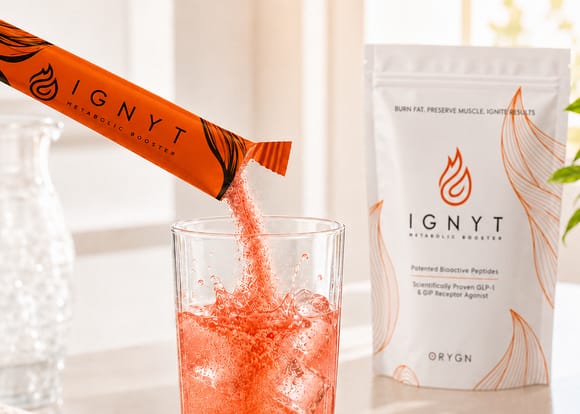
The cran-apple drink stick and the triGLP drops draw on the same studied ProGo® peptide, held to the same ORYGN PURE™ standard. Reformatting the ingredient into a powder doesn't cut it, thin it, or swap it for something lesser.
What changes between the two is delivery: a stick you stir into about eight ounces of water versus a liquid you take under the tongue. What doesn't change is the peptide itself or the standard it's held to. Flavor and format are wrapped around the ingredient; they don't replace it or reduce it.
If anything, the point of the powder is consistency of a different kind — the human kind. A format you enjoy is a format you keep using, and with peptide support, staying consistent is most of the value. For the mechanics of how the finished stick is meant to work, see How Ignyt Powder Works.
Salmon peptides come from fish, so anyone with a fish or seafood allergy should be cautious. While ProGo®'s peptides are small fragments and the ingredient is described as hypoallergenic, that means lower-risk — not risk-free. Read the product label carefully and talk to a qualified healthcare provider before starting if you have any fish or seafood allergy. We can't tell you it's safe for everyone.
It means the ingredient is formulated to be lower-risk for allergic responses, because it's made of small peptide fragments rather than large, intact proteins — and large proteins are what most often trigger food allergies. Hypoallergenic describes reduced likelihood, not a promise of safety for every person. If you have known allergies, check the label and ask your healthcare provider.
A Dalton is just a unit for weighing extremely small things like molecules — think of it as the scale used for the microscopic world. When ProGo® is called a "low-Dalton" peptide, it means the peptide is a small, short chain rather than a big protein. Smaller fragments are generally easier for the body to take up and use.
No — and this is an important distinction. FDA New Dietary Ingredient (NDI) status means the ingredient has gone through a notification process with the FDA. It is not FDA approval, and no dietary supplement carries FDA approval. NDI status is about the regulatory pathway for the ingredient, not a verdict on any product's results.
Yes. Ignyt Powder and triGLP drops use the same studied ProGo® salmon peptide, held to the same ORYGN PURE™ standard. The difference is format — a cran-apple drink stick versus sublingual drops — not the ingredient inside.
No. Moving the peptide into a flavored drink stick doesn't dilute it. Both Ignyt and triGLP are built on the same ProGo® peptide and the same ORYGN PURE™ standard. Flavor and format sit around the ingredient; they don't replace it. The choice between the two is about which routine you'll keep up, not which is "stronger."
Structure/function claims describe how an ingredient may support the body's normal structure or function — the kind of language dietary supplements are permitted to use, separate from disease claims. Thirteen are recognized for ProGo®. They describe the studied ingredient, not a specific outcome from the finished drink, and individual results vary.
ORYGN PURE™ is the standard behind the ProGo® salmon peptide in Ignyt — the same studied ingredient as triGLP, moved into a cran-apple drink stick without cutting corners on purity. It's a dietary supplement, not a medication. Individual results vary.
Shop Ignyt →